Every week in Ireland, a construction worker dies by suicide. Not on site. Not from a fall or a machine. At home, alone, with nobody knowing how bad it had gotten.
The industry talks constantly about physical safety. Harnesses, guardrails, toolbox talks. And still, the leading cause of death for men working in Irish construction is not a site incident. It is themselves.
The Numbers Nobody Puts on a Safety Poster
Men account for roughly 80% of all deaths by suicide in Ireland. Construction workers are overrepresented in that figure by a significant margin. Research from Pieta and the Construction Industry Federation has consistently shown that construction has the highest suicide rate of any sector in the country.
This is not a new finding. It has been known for years. And the industry's response, broadly speaking, has been to put a helpline number on the back of a hard hat sticker and call it a wellbeing programme.
The problem is not awareness. Most workers know Samaritans exists. The problem is a culture that treats asking for help as a form of weakness so profound it is career-threatening.
What Stoicism Looks Like on a Monday Morning
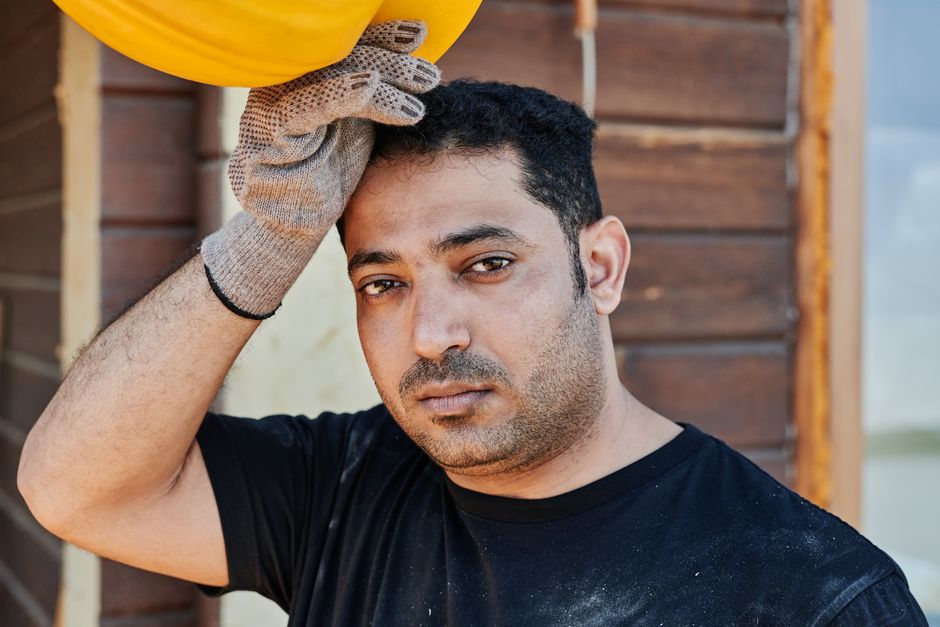
A lad shows up to site Monday morning. He hasn't slept properly in three weeks. His relationship is falling apart. He's drinking more than he should be. He owes money he doesn't know how to pay back.
He says nothing. He picks up the tools. He gets on with it.
And every single person around him does exactly the same.
This is not weakness. This is adaptation. Construction sites, particularly in Ireland, run on a very specific social contract. You carry your weight. You don't complain. You handle it. The men who built this culture were not cruel. They were doing what they had been taught, passing it on as the only way they knew.
The problem is that stoicism works fine for inconvenience. It is catastrophic for mental illness.
Why the Culture Is So Hard to Shift
Three things keep this going.
First, job insecurity. A huge proportion of construction workers are self-employed, on short contracts, or operating in environments where being seen as difficult or unreliable means you do not get called back. Admitting you are struggling carries a real professional cost.
Second, masculinity norms that are particularly intense in physical trades. The ability to work hard and not complain is not just a preference in this sector. It is identity. Threatening it feels like threatening everything.
Third, the absence of visible leadership on mental health. When a foreman has never once heard a site manager talk about mental health as a normal subject, he has no framework for bringing it up himself. Silence at the top produces silence all the way down.
Mental health at work is now a legal obligation, not an optional add-on. The Safety, Health and Welfare at Work Act 2005 covers psychological health as clearly as it covers physical hazards. Employers who think a hard hat poster discharges their duty are wrong, and increasingly exposed.
What Actually Helps
Helpline numbers are not useless. But they ask someone in crisis to take a significant, visible, stigmatised step entirely alone. Most people will not do that.
What works better is removing the step. Normalising mental health conversation before someone reaches crisis point.
Concretely, this means:
Trained mental health first aiders on site. Not HR. Not management. A colleague. Someone at the same level who has been given skills and permission to notice when someone is not okay and say so. The Mental Health First Aid in the Workplace framework exists and is being used in Irish workplaces. It works precisely because it does not require a worker to seek help from someone in authority.
Talking about it in toolbox talks. Not once a year for Mental Health Awareness Week. Regularly. The same way you'd talk about a near miss or a new risk. Suicide prevention charity Mates in Construction has developed toolbox talk resources specifically for the sector. They are free. They are practical. There is no excuse for not using them.
EAP schemes that workers actually know about. Employee Assistance Programmes are available through most major contractors and CIF-affiliated employers. Usage rates are embarrassingly low because nobody talks about them. Put the number on the pay slip, not just the induction pack nobody reads.
Leadership modelling. A site manager who mentions going to counselling after a hard year does more for mental health on that site than six years of poster campaigns. It only has to happen once to shift the frame entirely.
The Financial Argument, For Those Who Need It
Presenteeism costs Irish construction employers more per year than absenteeism. A worker showing up unwell, distracted, not sleeping, operating heavy machinery in that state, is a physical safety risk as well as a personal one. The HSA's own research links worker fatigue and psychological distress to an increased risk of site incidents.
So the case for mental health investment is not just humanitarian. It is the same case you make for any other site safety measure. It reduces harm. It reduces liability. It reduces the chance of a phone call nobody wants to make.
The Turn
The industry knows the numbers. It has known them for a decade. Continuing to respond with a sticker on a hard hat is not neutral. It is a choice. And it is a choice with a body count.
If you are working in construction right now and you are not okay, Samaritans are available 24 hours a day on 116 123. Mates in Construction operate a dedicated construction worker helpline at 1800 939 122. You do not have to be in crisis to call. That is the whole point.