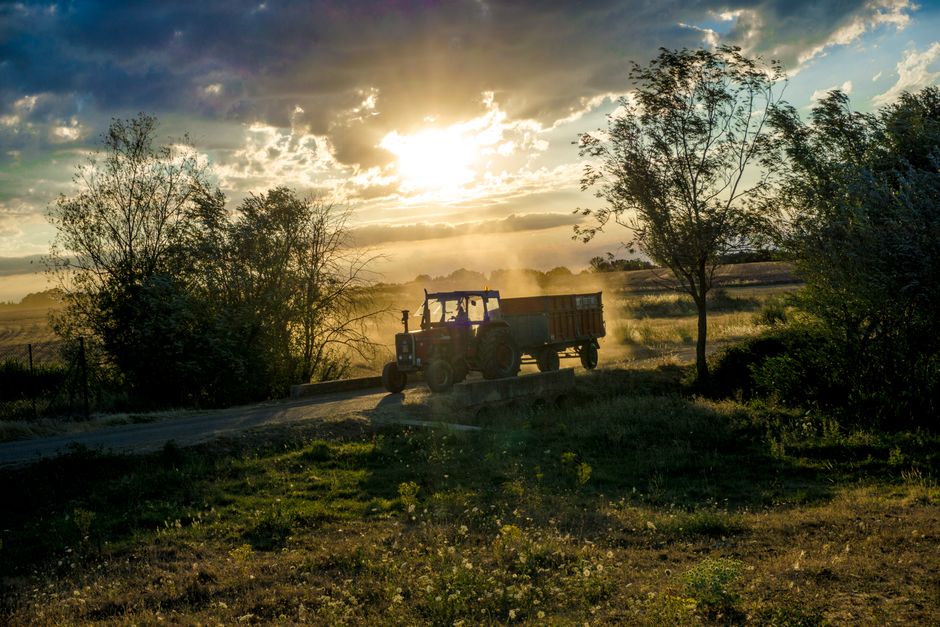
Every year, the National Ploughing Championships draws 300,000 people to a field in rural Ireland. Machinery everywhere. Slow-moving vehicles on local roads. Pedestrians where there were none the day before. And almost nobody treating the journey in as a hazard worth thinking about.
That is the problem in miniature. Agricultural roadways are treated as the informal bit, the bit before the real work starts. They are not.
The Numbers Nobody Quotes at the Gate
Agriculture is consistently the most dangerous sector in Ireland by fatality rate. The Health and Safety Authority records between 10 and 20 farm deaths every year, and transport incidents, including those involving agricultural vehicles on public and private roads, account for a significant share. Tractors overturn. Loads shift. Drivers of other vehicles meet machinery on blind bends at speeds that leave no margin.
The roads connecting farms to the wider network are not designed for modern agricultural equipment. A combine harvester or a large bale trailer can be 3.5 metres wide. Most rural roads in Ireland are 5 to 6 metres wide, total. When two vehicles meet, physics does the maths very quickly.
What Actually Makes These Roads Dangerous
Speed is the obvious one, and yes, rural drivers often move too fast for the surface and sight lines they are dealing with. But the deeper problem is expectation mismatch. Car drivers do not expect a tractor and slurry tanker to come around a bend at 7am. Tractor drivers do not always expect a car to be overtaking on a hill. Nobody expects the bale that worked loose three kilometres back to be sitting in the road.
Unmarked agricultural laneways add another layer of risk. A farm gate that opens directly onto a public road with zero visibility in either direction is not unusual in Ireland. There is no signage requirement, no white lines, no give way markings. The farmer using that gate every day knows to ease out slowly. Visitors, contractors, and seasonal workers often do not.
Load Safety on Rural Roads
An unsecured load is a projectile waiting for the right corner. The Road Traffic Act and Road Traffic (Construction, Equipment and Use) Regulations require loads to be secured so they cannot shift, fall, or trail. In practice, enforcement on rural roads is thin.
Round bales weigh between 250 and 600 kilograms. A silage trailer carrying 15 bales, with a single chain that has gone slack, is not a minor oversight. When a bale comes off a trailer on an open road, the driver behind has seconds to react, and usually less than that.
Slurry tankers bring a different problem. Sloshing liquid shifts the centre of gravity continuously. On a cambered road or an uneven surface, a tanker that is not properly baffled can destabilise a tractor in a way the driver cannot anticipate.
Cargo loading deaths are rising, and the failure patterns are consistent: inadequate restraint, inadequate inspection before departure, and no system for checking loads mid-journey on longer hauls. Rural agriculture has the same gaps with far less oversight.
Machinery Blind Spots on Agricultural Routes
Large agricultural vehicles have significant dead zones. The driver of a tractor with a front loader, or a combine with a header attached, is working with very limited visibility to the sides and rear. Cyclists, pedestrians, and small vehicles disappear into those blind spots entirely.
The Ploughing Championships makes this concrete. You have tens of thousands of visitors, many of them walking on roads, alongside agricultural vehicles moving in and out of the site. Even experienced operators are managing unfamiliar terrain, unfamiliar traffic patterns, and equipment that was never designed for pedestrian-heavy environments.
The same blind spot dynamics that kill construction workers apply on agricultural roads. The machine does not change shape because the context is rural. The risk does not shrink because the victim is a neighbour.
What the Rules Actually Say
Under the Safety, Health and Welfare at Work (General Application) Regulations, employers, including farm employers, must manage risks from workplace transport. Farms that employ workers are covered. But sole traders and family farms operating without employees fall outside the direct scope of most workplace transport obligations, which leaves a large portion of the sector operating on custom and habit rather than assessed procedure.
Road traffic law does apply to agricultural vehicles on public roads. Maximum road speed for tractors without pneumatic tyres is 24 km/h. For tractors with pneumatic tyres, it is 40 km/h. Wide loads over 2.5 metres require an attendant or escort in certain conditions. Loads must be secured.
The gap between what the law requires and what actually happens on a Tuesday morning in October when silage needs to be moved is significant.
What Farmers and Rural Drivers Can Do Today
The fixes are not complicated. They require decision-making, not budget.
For farmers operating vehicles on public roads:
- Walk the route before moving wide or heavy loads. Note sight lines, passing places, and road surfaces.
- Check load restraints before departure and again after 2 kilometres if carrying bales or loose material.
- Use a banksman when reversing out of gated entrances onto public roads.
- Fit slow-moving vehicle triangles and keep lighting clean and functional. A mud-caked rear light is invisible.
- If operating near an event or unfamiliar traffic volume, reduce speed and increase following distance.
For rural drivers sharing roads with agricultural vehicles:
- Do not overtake on bends, hills, or within 100 metres of a junction, even if the tractor ahead appears to be moving slowly.
- Assume the driver cannot see you until proven otherwise.
- If you encounter a wide load, stop and wait. The 90 seconds it costs is not worth the alternative.
The Turn
Events like the National Ploughing Championships are good for farm safety awareness. Stands, demonstrations, HSA presence. But the risk is not at the event. It is on the R-road getting there, with a bale trailer and a school run, at the same time, on a road that was built for horses.
The conversation about agricultural road safety needs to happen before someone is standing at a gate trying to explain why a load came off. Start it now, and the checklist is short.