Roadworks are where two worlds collide: a live construction zone and 80 km/h of moving traffic separated by a line of plastic cones. Someone always thinks the rules do not apply to them. Sometimes they find out they were wrong in the worst possible way.
Ireland has more roadworks running simultaneously than at any point in its history. TII schemes, local authority resurfacing, utility diversions, rural broadband infrastructure. The cones are everywhere. And yet the behaviour of drivers passing through them has not improved to match the volume of work. Contractors face heavy fines for roadworks safety breaches when their traffic management fails. But the driver who ignores the limits and injures a worker faces criminal prosecution, a driving ban, and the kind of consequences that follow a person for life.
What the Signs Are Actually Telling You
Temporary signage on Irish roadworks follows the Traffic Signs Manual and the DMRB standards that Transport Infrastructure Ireland applies to national roads. The signs are not suggestions. They carry the same legal weight as permanent signs.
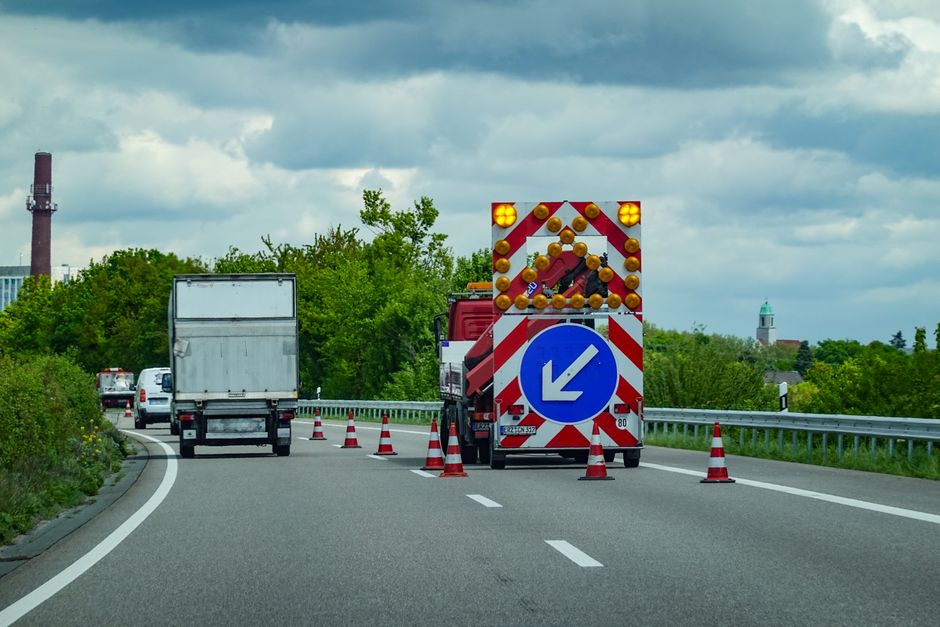
The sequence works like this. You will see an advance warning sign, typically 200 to 300 metres before the works. Then lane closure ahead signs. Then the taper, where cones narrow the carriageway. Then the working area itself. Each element is deliberate. The advance warning gives you time to check your mirrors, reduce speed progressively, and position correctly before the taper begins.
Drivers who brake hard at the taper are the ones who ignored the advance warning. They are also the ones most likely to rear-end the vehicle in front when traffic backs up suddenly.
Temporary Speed Limits: These Are Enforceable
A temporary speed limit displayed on a roadworks sign has full legal force under the Road Traffic Act. Gardaí enforce them. Speed cameras, including mobile units, operate in and around roadworks. The standard temporary limit on Irish national roads is 50 km/h through the working area, though this varies by scheme.
The limit applies from the sign to the end-of-restriction sign. Not from where you can see workers. Not from where the cones get tight. From the sign.
Penalty points apply exactly as they would for a fixed speed limit. Two points for exceeding the limit by less than 30 km/h. Four points above that threshold. Add a Fixed Charge Notice of up to €160 and the possibility of a court appearance for significant excess. Judges are not sympathetic when a worker's life was at risk.
Contraflow and Lane Closures
A contraflow means traffic in both directions shares a reduced number of lanes, typically separated by cones rather than a central barrier. The working side of the road is closed. You are driving in what used to be oncoming traffic's space.
The rules here are simple. Keep left. Keep your speed at or below the limit. Do not overtake within the contraflow. The lanes are narrower than you are used to. The gap between you and oncoming traffic is smaller than it looks. HGVs in a contraflow feel very close because they are very close.
If a contraflow uses a convoy system, you follow the lead vehicle at a consistent speed. Do not accelerate past the pilot. Do not close the gap so tightly that you have no stopping distance.
Stop-Go Boards: What the Operative Expects From You
A stop-go board is not a traffic light. It is a person. A trained traffic management operative standing at the edge of a live construction zone, holding a reversible sign, with vehicles passing within arm's reach. That person expects you to treat their signal the same way you treat a red light. Because legally it is exactly that.
When you see the red STOP face, stop before the operative. Not beside them. Before them. Leave enough space for vehicles to exit the works if needed.
When the sign flips to GO, that does not mean accelerate. It means proceed when safe. Check that the vehicle in front has moved, that there is clearance ahead, and then move at a controlled speed. The working area beyond the operative is still a live zone. Workers, plant, and equipment are present on both sides.
The operative will often make eye contact and use a hand gesture to confirm you should proceed. Acknowledge them. It takes nothing.
Do not creep forward while the STOP face is showing. Do not inch past the line because you think you can squeeze through. Do not sound your horn at an operative. These are not quirky suggestions. Workers have been struck by drivers who decided the operative was taking too long.
Night Works and Poor Visibility
Night roadworks bring additional risk. Floodlighting creates harsh contrasts. The area inside the lights appears bright, but your eyes take time to adjust when you exit into darkness. Speed feels slower at night than it is.
Reflective clothing on workers and retroreflective cones are there because visibility drops dramatically. If you can see the operatives, good. If you cannot see them clearly, slow down more than you think necessary. Your headlights illuminate a fraction of what daylight shows you.
What Happens When a Driver Hits a Worker
It is not a traffic matter. It is a criminal investigation. An Garda Síochána will examine your speed from CCTV, speed cameras, and witness accounts. They will check if you were on a phone. They will look at your approach line and braking pattern. If you were speeding, the case goes beyond Fixed Charge Notices into prosecution for dangerous driving causing serious harm or death. The minimum sentences are not trivial.
Contractors and local authorities also face civil claims if their traffic management contributed. But that does not reduce your liability as a driver. Both can be found responsible.
The Practical Checklist Before You Enter Any Roadworks
Read the signs from the first advance warning. Reduce speed before the taper, not at it. Position in lane early. Cancel any overtake you were planning. Be ready to stop at a moment's notice. When a stop-go operative signals you, treat it as a legal instruction. Watch for pedestrians, cyclists, and workers crossing within the zone. Exit the works at the posted limit, not at whatever felt appropriate inside.
The person with the stop-go board has probably had a vehicle pass within centimetres of them this week. The least you can do is slow down.