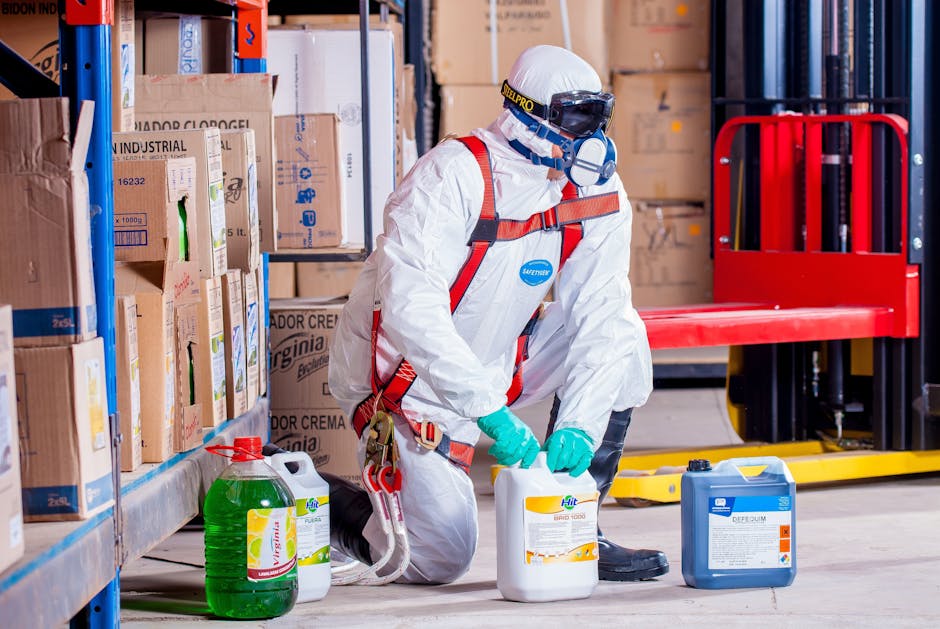
Caustic soda does not wait for a supervisor to arrive. It keeps burning through tissue for as long as it stays in contact with skin, and the difference between a recoverable injury and a life-changing one is often measured in seconds.
The £3.8 million HSE (UK) enforcement case that followed a caustic soda exposure incident at a food processing facility was not unusual because the chemical was dangerous. It was unusual because the company's workers had no idea what to do when it went wrong. No trained first aider on shift. Emergency shower not tested in months. A safety data sheet locked in a filing cabinet that nobody had read. The exposure that could have been interrupted in under a minute instead caused full-thickness burns. That detail matters because it keeps happening, in Ireland and the UK alike, in factories, cleaning operations, agriculture, and food production.
The chemistry is worth understanding briefly. Alkali burns from caustic soda (sodium hydroxide) are typically worse than equivalent acid burns. Acids tend to cause a surface reaction that slows further penetration. Alkalis keep going. They saponify fat tissue, which is a clinical way of saying they dissolve it. A pH of 14, which is what you are dealing with in concentrated sodium hydroxide, will cause progressive necrotic damage for minutes after contact if nothing interrupts it.
The First 60 Seconds
Flush immediately. That is the whole first step. Not "find the safety data sheet." Not "call the supervisor." Not "locate the first aid kit." Flush with large volumes of water for a minimum of 20 minutes, and start that clock only when the water is actually running over the affected area.
The instinct to hesitate, to find help first, to get someone else involved before acting, costs tissue. The person affected should move to the nearest water source, whether that is an emergency eyewash station, a safety shower, a regular tap, or a hose. Cold water is fine. There is no benefit to warm water and no reason to wait for it.
Remove contaminated clothing during flushing, not after. A soaked sleeve or trouser leg is a reservoir of chemical sitting against skin. Gloves, if worn, come off immediately.
Do not apply anything. No creams, no neutralising agents, no vinegar, no baking soda. The instinct to neutralise an alkali with an acid sounds logical and is genuinely dangerous. The neutralisation reaction generates heat and makes the burn worse.
Eyes and Inhalation
Chemical splash to the eyes requires the same response: immediate and sustained flushing. Dedicated eye wash stations should deliver at least 15 minutes of low-pressure irrigation. Tilt the head so the chemical flushes away from the unaffected eye rather than across it. Hold the eyelid open. It is uncomfortable and the person will resist it. Hold it open anyway.
Inhalation of caustic dust or mist causes airway irritation that can progress to pulmonary oedema hours later. A worker who has inhaled significant quantities of sodium hydroxide fume and feels fine at the scene is not out of danger. They need hospital assessment even if symptoms seem mild.
Calling Emergency Services
Call 999 (or 112) as early in the process as possible, ideally while flushing is already underway. Tell the dispatcher the specific chemical. Do not say "cleaning product." Say sodium hydroxide, or the trade name, or read the container. The receiving hospital needs to know what they are treating before the patient arrives. Ambulance crews and emergency departments use this information to prepare.
Keep the product container or safety data sheet to hand for the crew. If a colleague is helping, one person flushes and one person calls. That is the entire response plan in its simplest form.
What Good Preparation Actually Looks Like
Emergency first aid at work starts before an incident. For any workplace handling corrosives, that means a few specific things that are not optional.
Safety showers and eyewash stations need weekly activation checks. Not annual. Not when the inspector visits. Weekly. Plumbed eyewash stations can harbour Legionella if they sit dormant. Gravity-fed bottles expire and lose sterility. A station that has never been tested is a false comfort.
The first aider on site needs chemical-specific training, not just a generic QQI Level 3 card. They need to know the properties of the chemicals actually used in that workplace. Caustic soda behaves differently to hydrofluoric acid, which behaves differently to sulfuric acid. Just as crush injuries and amputations require specific first responder knowledge, chemical burns have their own response logic that generic training does not fully cover.
Signage at chemical storage points should show the immediate first aid action, not just the GHS hazard pictograms. Workers should be able to read the response in three seconds and act on it without needing to find a document.
The Gap Between Knowing and Doing
Most workplaces that have suffered a serious chemical burn incident had a safety data sheet on file. Many had some form of first aid cover. What they did not have was a worker who, in a moment of shock and panic, knew exactly what to do with their hands in the next thirty seconds. That gap is a training failure, not a documentation failure.
The £3.8 million enforcement action is a useful number. It covers prosecution costs, compensation, and the extended enforcement that follows a serious incident. The actual cost of an emergency shower that works and a worker who has practised using it is, by comparison, embarrassingly small.
Chemical burns respond to one thing in the acute phase: water, applied immediately, for long enough. Get that right and the rest of the response has a chance to work.