Every year, road workers in Ireland set up at sites where the traffic management plan was written the night before, signed by someone who hadn't visited the location, and ignored by the crew from minute one. Then something goes wrong.
If your company opens up a carriageway without a proper traffic management plan for road works in place, you are not in a legal grey area. You are exposed, and so is everyone working in that zone.
Who Is Legally Responsible for the Plan
The Roads Act 1993 and the Safety, Health and Welfare at Work (Construction) Regulations 2013 both touch this area, but the practical framework comes from Transport Infrastructure Ireland and local authority licensing conditions. The utility company, contractor, or local authority opening the road is responsible for preparing the plan before work starts. Not during. Not on the morning of.
In practice, a competent person with relevant traffic management training must sign off the plan. "Competent" here means demonstrable knowledge of Chapter 8 of the Traffic Signs Manual, site-specific risk assessment, and the ability to translate both into a layout that actually works on the ground. A signed form from someone who has never been to the site does not satisfy that test. Inspectors know the difference, and roadworks safety failures of exactly this kind have resulted in prosecutions and fines running into seven figures.
What Chapter 8 Actually Requires
Chapter 8 of the Traffic Signs Manual is the operational bible for roadworks traffic management in Ireland. It sets out signing, guarding, and lighting requirements for every category of road, every type of works, and every speed environment. The key elements inspectors check against it include:
Advance warning signs. These must be placed at distances calculated from the speed limit of the road, not the speed vehicles are actually doing. On a 100 km/h national road, the first warning sign goes at a minimum of 200 metres from the works. Getting this wrong by 50 metres is not a minor error.
Taper length and lane narrowing. Chapter 8 specifies minimum taper ratios for merging traffic. A taper that is too short creates shear-force collisions. The formula is not optional.
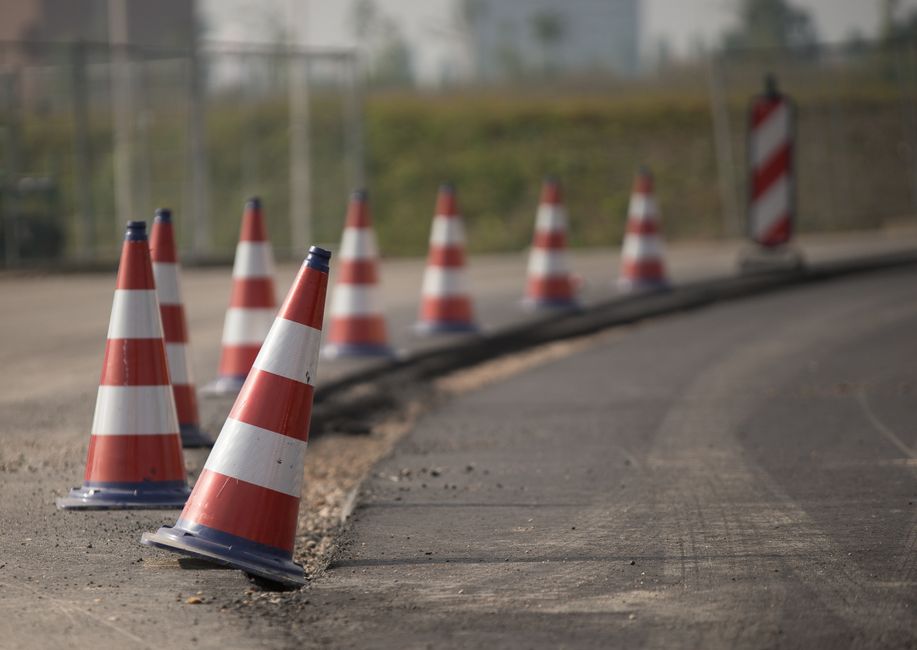
Longitudinal spacing of cones. On high-speed roads, cones are placed every 5 to 10 metres along the taper and at regulated intervals along the lane closure. Spacing them further apart because you are short on cones is a non-compliance that shows up on every inspection.
Speed limit orders. Reducing the speed limit through a works zone requires a Temporary Speed Limit Order from the relevant local authority or TII. A hand-painted sign does not constitute a legal speed reduction. Vehicles travelling at 100 km/h through your 50 km/h works zone are not breaking the law if the order was never put in place.
Lighting and reflective equipment. At night, or in conditions of poor visibility, all signs, cones, and barriers must be retro-reflective or illuminated. Torches held by operatives do not count.
Works vehicles and plant. Any machine within or adjacent to the carriageway must be marked with amber beacons and, where relevant, road-marking vehicles must carry the correct arrow boards and impact protection.
The Gaps Inspectors Find Most Often
TII and local authority inspectors are not looking for creative interpretations of Chapter 8. They are checking against a list, and the same failures appear on it repeatedly.
No plan on site. The traffic management plan must be on site and available for inspection. Not in the van. Not in the contractor's office in Athlone. On site, accessible, and reflecting the actual layout in use. If the layout has changed since the plan was drawn, the plan must be updated before the change is made.
Untrained operatives. Anyone placing signs, cones, or barriers on a live road must hold a Safe Pass and, for more complex works, a traffic management qualification such as those issued under the Lantra or IOSH frameworks. Putting an unqualified labourer out to set up a lane closure on a national road is both a training failure and a legal one.
Wrong sign types. Chapter 8 is specific about which signs apply to which scenario. Using a general "Road Works Ahead" sign when the situation requires a "Lane Closed" sign with directional arrows is a technical non-compliance. It also confuses drivers, which is the entire problem the signs exist to prevent.
Inadequate buffer zones. The longitudinal buffer between the end of the taper and the first worker or excavation must meet minimum distances. Inspectors measure these. Short buffer zones are one of the most common reasons workers are struck.
No Emergency Access Plan. For any works that restrict carriageway width or close a lane, the plan must address how emergency vehicles can access the works zone and beyond it. This is a life-safety issue that gets treated as a box-ticking exercise far too often.
The Notification Requirements Nobody Reads
Before closing a lane on a public road in Ireland, you need more than a plan. You need approvals. Local authorities issue road opening licences, and the conditions attached to those licences specify minimum notification periods, utility strike avoidance requirements, and reinstatement standards. TII approval is required separately for national roads.
Garda notification is mandatory for works on busy routes, particularly where lane closures will extend beyond a single shift. An Garda Síochána must be informed in writing, not phoned the morning you start. Some authorities also require notifying the National Transport Authority if the closure affects bus corridors.
The Turn
Chapter 8 and the associated licensing frameworks are not complicated documents. The requirements are specific and, in most cases, entirely achievable with a day's planning. The reason inspectors keep finding the same failures is not that the regulations are unclear. It is that the planning is treated as an administrative inconvenience rather than the operational control it actually is.
A traffic management plan for road works is not paperwork. It is the thing that keeps a driver from ploughing through your crew at 90 km/h because they got no advance warning the road layout had changed.
Get it right before the first cone hits the tarmac, or deal with the consequences after.