Every fatal reversing incident has the same shape. A vehicle moves backward. A person is somewhere they should not be, or somewhere nobody knew they were. The two meet. Somebody dies.
That shape has repeated itself on Irish construction sites, in warehouses, on farms, and in factory yards for decades. The HSA's fatality statistics bear this out year after year. Vehicles in motion, people on foot, and a blind spot that nobody managed. The machinery changes. The outcome does not.
What the Court Cases Show
Recent prosecutions tell a consistent story. An employer gets fined. The judge notes that basic segregation measures were absent. A banksman was not assigned, or was assigned but had no clear authority. A reversing alarm was fitted but nobody checked whether it worked. A camera was installed but the driver was not trained to use it properly.
These cases have a financial shape too, but the more important pattern is operational. In almost every fatal reversing incident, you find a site where pedestrians and vehicles shared space without formal separation, where the reversing risk was either not assessed or assessed and then ignored.
The law is not ambiguous here. The Safety, Health and Welfare at Work (General Application) Regulations 2007 require that traffic routes are designed to keep pedestrians and vehicles apart. The 2013 Construction Regulations reinforce this for sites specifically. Employers know this. The incidents happen anyway.
Why Forklifts and Telehandlers Are a Specific Problem
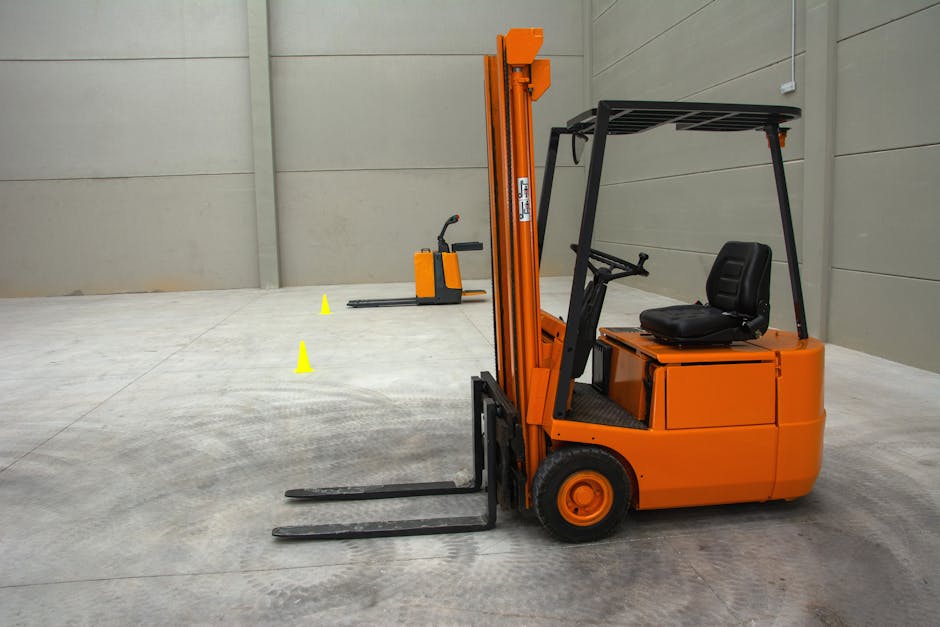
A counterbalance forklift has a rear-swing radius that catches people off guard. When a loaded forklift turns, the rear of the machine swings outward. Drivers know this. Pedestrians often do not. Add reverse travel and you have a vehicle moving in a direction the driver cannot fully see, in a yard where nobody has formally told pedestrians where not to stand.
Telehandlers are worse for visibility. The boom, depending on its position, can block significant portions of the driver's rear sightline. The cab sits high. Pedestrians working near ground level are simply not visible through mirrors or camera systems, particularly in corners, around racking, or near loading bay doors.
The weight of these machines compounds everything. A 3.5-tonne forklift reversing at walking pace generates enough force to kill. There is no minor outcome when it contacts a person.
Warning Systems: What Actually Works
Reversing alarms are the default response and they are inadequate on their own. On a busy site with multiple machines running simultaneously, audible alarms become background noise within weeks. Workers habituate to them. The alarm sounds, nobody looks up. This is not laziness. It is basic human psychology.
Camera systems are better than alarms alone, but a reversing camera is not a silver bullet. Camera feeds are only useful if the driver is watching them, has been trained to interpret what they show, and the camera itself is positioned and maintained correctly. Mud, condensation, and physical damage degrade the image. A driver under time pressure will keep moving.
Radar and proximity detection systems represent a meaningful step up. These systems detect objects in the vehicle's path and alert the driver regardless of camera visibility. Some variants trigger an automatic brake hold. They are more expensive than a camera retrofit. They are considerably cheaper than a fatality and the prosecution that follows.
The most effective interventions are physical and organisational, not technological. Hard segregation means barriers, kerbs, and designated pedestrian walkways that vehicles physically cannot enter. It means separate gates for workers and delivery vehicles. It means a site layout designed so that reversing happens in places where pedestrians have no reason to be.
The Banksman Question
A trained banksman, properly positioned with clear line of sight and genuine authority to stop a vehicle, works. The problem is how the role gets implemented in practice. On too many sites, banksman duties are informal. A worker waves a truck back because they happen to be nearby. They have no training, no high-visibility vest, no agreed signal system, and no authority to refuse the driver's judgment.
That is not a banksman. That is a witness.
When you look at HSA enforcement notices and prosecution outcomes, the banksman failure mode appears repeatedly. The role existed on paper. The competence and authority did not exist in practice.
What a Proper Traffic Management Plan Looks Like
Every site with reversing vehicles needs a written traffic management plan. Not a paragraph in the safety statement. A plan that shows vehicle routes, turning areas, reversing zones, pedestrian routes, crossing points, and where those two systems interact.
The plan needs to answer specific questions. Where do vehicles reverse? Who can be in that area when reversing happens? What is the signal for an all-clear? Who has authority to halt a vehicle movement?
That plan also needs to change when the site changes. A traffic management plan drawn up during groundworks becomes dangerously out of date once steel is going up and the yard layout shifts. Static documents do not manage dynamic sites.
Supervisors need to understand the plan and enforce it. A project supervisor who treats traffic management as a paperwork exercise rather than a live operational concern is creating the conditions for a fatality.
The Employer Calculation That Keeps Going Wrong
Some employers still weigh up the cost of proximity detection systems, proper banksman training, and hard segregation infrastructure against the probability of an incident and decide the investment is not justified. This calculation is wrong for two reasons.
First, the probability is not low. Reversing vehicle incidents are among the most common fatal incident categories in Irish workplaces. The HSA publishes this data openly. The risk is not theoretical.
Second, the post-incident costs dwarf any prevention spend. A prosecution under the 2005 Safety, Health and Welfare at Work Act can result in fines up to €3 million and imprisonment for individuals. That excludes civil litigation, reputational damage, and the operational disruption that follows a fatal incident investigation.
The money argument for prevention is not close. It is not even a contest.
The Turn
The technology to prevent most reversing fatalities exists, is available, and is affordable relative to the consequences of not using it. The regulatory framework is clear. The HSA has been prosecuting these cases for years and the pattern has not changed. That means the problem is not knowledge or law. It is implementation, supervision, and whether site management treats pedestrian and vehicle segregation as a real operational priority or a box to tick before the inspector visits.
Most of these deaths were preventable. That is the only sentence that matters.