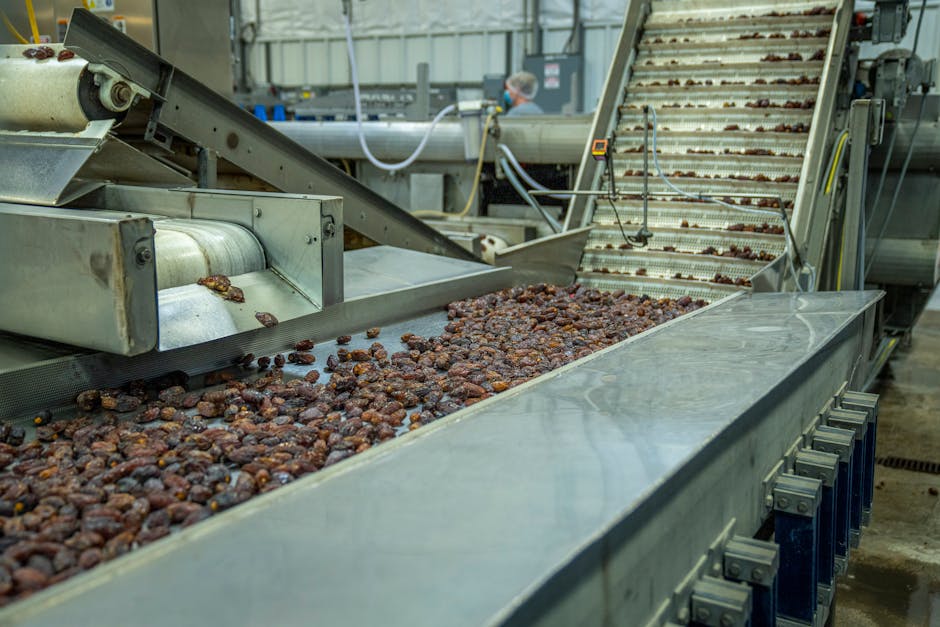
A conveyor belt moving at 1.5 metres per second gives you roughly three seconds to react before a caught sleeve becomes a crush injury. Most food plants are betting their workers have faster reflexes than that.
The waste recycling sector learned this the hard way, repeatedly, publicly, and expensively. Crush injuries from sorting conveyors and baling equipment have been showing up in HSA prosecution records for years. What gets less attention is that the same failure pattern runs straight through food manufacturing. Different product, different shift pattern, same dead hand on the emergency stop.
Food processing lines move fast by design. A poultry deboning line, a fish filleting belt, a ready-meal assembly conveyor: all of them run at speeds where contact means injury before the brain has finished registering the problem. The response to that reality should be engineering controls so robust that human reaction time is irrelevant. In too many plants, the response is a laminated sign and a toolbox talk from six months ago.
What Lockout/Tagout Actually Requires
Lockout/tagout, or LOTO, is the process of isolating energy sources before any maintenance, cleaning, or unjamming work on machinery. Under the Safety, Health and Welfare at Work (General Application) Regulations 2007, employers must ensure dangerous parts of machinery are made safe before anyone works on or near them. That is not a suggestion. It is a legal duty.
A proper LOTO programme means written procedures for every piece of relevant equipment, physical isolation of every energy source including electrical, pneumatic, and hydraulic, personal padlocks applied by each worker entering the danger zone, and verification that the machine cannot start before anyone puts their hands near it. The verification step is where most programmes quietly fall apart. Someone isolates the main isolator. Nobody tests whether the line is actually dead. A worker reaches in. The residual hydraulic pressure in a clamping mechanism does the rest.
The phrase "it was only going to take a second" appears in more incident investigation reports than any safety professional should ever have to read.
The Cleaning Shift Problem
Cleaning is the highest-risk activity in any food processing plant. That is not intuitive. Production gets the attention, the supervision, the trained operatives. Cleaning happens at 2am with a skeleton crew, possibly agency workers on their third week, working around equipment that is partially disassembled and wet.
Line cleaning requires access to exactly the places where the guards are not. Nip points, drive rollers, internal belt surfaces. The cleaning crew needs to get in there with brushes and pressure hoses to meet food hygiene standards, which are non-negotiable. The mechanical isolation requirements are equally non-negotiable. Holding both of those things to be true simultaneously, and building a system that handles both, is the actual job.
Plants that rely on "the line is off" as their cleaning safety standard are one accidental start button away from a fatality. The button might be hit by a maintenance engineer who didn't know the cleaning crew was still on the line. It might be triggered by a programmable logic controller running an automated restart sequence that nobody updated when the shift pattern changed. It has happened both ways.
Where Food Plants Diverge From Better-Regulated Sectors
The oil and gas sector has permit-to-work systems that would make a food plant manager's eyes water. Every isolation is documented, verified by a second person, and physically tagged before anyone enters. The paperwork is onerous. Nobody in that sector apologises for the paperwork, because the paperwork is the system that keeps people alive.
Food manufacturing sits in a strange middle ground. The machinery is genuinely dangerous, comparable to any heavy industry. The finger loss and crush injury patterns repeat with depressing consistency across sectors. But the safety culture in many food plants is closer to catering than to engineering, shaped by margins, by throughput targets, by the assumption that because the product is food it cannot be as dangerous as mining or construction.
That assumption is wrong and the HSA's prosecution record proves it.
The Unjamming Problem
A conveyor jams. Product backs up. The line stops. Production is losing money by the minute and the supervisor needs it fixed now. The operative has unjammed this particular point fifty times before without isolating. It takes thirty seconds if you just reach in carefully.
This is the scenario that produces the most injuries. Not reckless behaviour. Not ignorance. A fast, familiar, routine task that went wrong once.
The technical fix is straightforward: guard the nip points so they cannot be accessed without removing a guard that requires a tool, wire that guard removal into the isolation circuit, and require a positive restart procedure after any guard removal. The fix costs money upfront. It costs less than the legal exposure that follows a serious injury, which as detailed cases show can reach six figures in fines before civil liability enters the picture.
The harder fix is cultural. The supervisor who tells an operative to "just clear it quickly" is creating liability for themselves and their employer. The operative who reaches into a running machine is not the problem. The system that made that feel like the normal thing to do is the problem.
What a Functional LOTO Programme Looks Like in Practice
A working programme has five components that actually function, not five boxes ticked on an audit form.
Written machine-specific procedures with photographs, not generic instructions. Workers should be able to pick up the sheet for conveyor line 4 and know exactly which isolators to lock, in what order, and how to verify isolation.
Personal padlocks for every worker. Not a single supervisory padlock on the group box. Every person in the danger zone holds their own key. The line cannot restart while their padlock is on the hasp. That is the point.
Training records that show operatives demonstrated competency, not just attended a session. There is a difference.
A system for handling shift handovers where an isolation is still in place. Documented, signed, with the incoming worker applying their own padlock before the outgoing worker removes theirs.
Regular audits by someone who knows what they are looking for and has authority to stop production when they find a gap.
The Three Seconds
The three-second window in the title is not a metaphor. At typical food processing line speeds, contact to serious injury takes under three seconds. Human reaction time to an unexpected stimulus is 0.2 to 0.3 seconds. By the time the brain has registered what is happening, the injury is already in progress.
Engineering out the hazard is the only reliable answer. LOTO is not a response to an incident. It is what prevents the incident from being possible in the first place.
The waste recycling sector has paid for its education in this area with serious injuries and prosecution costs. Food manufacturing has the same hazards, the same legal obligations, and the same three-second window. The question is whether the lesson needs to be relearned from scratch or borrowed from an industry that already paid for it.
The conveyor does not care what product it is carrying.