Silica dust gives you a decade, sometimes two, before it kills you. That gap between exposure and consequence is exactly why nothing changes.
The HSA has run campaigns. Posters go up. Toolbox talks get logged. Then the angle grinder fires up on a block wall with no water suppression and no mask in sight, and everyone moves on because there's a deadline to hit and the guy has been doing this for twenty years and he's grand. That logic has a body count.
What the Dust Actually Does
Crystalline silica sits in concrete, sandstone, brick, mortar, and fibre cement sheeting. When you cut, grind, drill, or scabble those materials dry, the particles go airborne. The ones you need to worry about are below 10 microns. You cannot see them. You breathe them deep into the lung tissue, and the body cannot remove them. It walls them off with scar tissue instead. That scarring is silicosis, and it does not reverse.
Silicosis in 2026 is killing workers in their forties, some diagnosed before they hit fifty. Accelerated silicosis, caused by intense short-term exposure, can develop within five years. It is also a Group 1 carcinogen for lung cancer. The occupational exposure limit in Ireland is 0.1 mg/m³ as a time-weighted average over eight hours. Dry cutting a single concrete block with an angle grinder can exceed that limit by a factor of ten within minutes.
The Time Pressure Problem
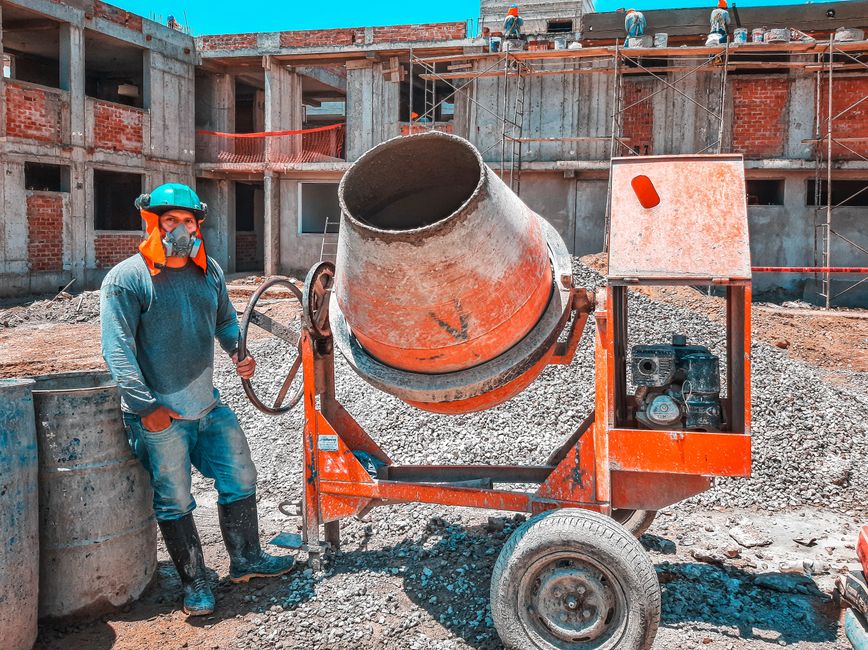
Construction moves on programme. A groundworks subcontractor is not paid to wait for water suppression to be set up. A bricklayer cutting reveals does not want to break rhythm to fit a tight-fitting P3 respirator that fogs his safety glasses. The moment respiratory protection adds friction to a task, it loses.
Disposable FFP2 masks cost next to nothing and offer minimal protection against fine silica particles. A properly fitted half-face respirator with P3 filters costs around 30 to 40 euro and requires fit testing to work. Fit testing takes time and costs money. On a site running tight margins with subbies trying to hit their day-rate, that conversation does not happen.
This is not a knowledge gap. Most experienced tradespeople know silica is dangerous. The barrier is structural. Nobody has built the control into the workflow.
The Cultural Normalisation
There is a particular kind of site culture that mistakes tolerance for toughness. Dust is just dust. The mask is for snowflakes. The lads who have been cutting dry for thirty years are still standing, so clearly it's not that bad. That logic would be funny if it weren't so effective at killing people.
Occupational asthma and respiratory disease share this same cultural blind spot. The damage accumulates invisibly. You feel fine until you don't, and by then the disease is irreversible. There is no surgical fix for a fibrosed lung.
The comparison to asbestos is worth making directly. Asbestos was normalised for decades on Irish sites. Workers were told it was fine. Some were told to stop being dramatic. We now know the cost of that normalisation, and it is still being paid. Silica is following the same script, just on a shorter timeline.
Why Campaigns Alone Don't Cut It
The HSA campaigns are not wrong. The information is accurate and the intent is genuine. But a poster in a site cabin does not change what happens when a subcontractor under pressure picks up a grinder. Campaigns work on awareness. The awareness already exists. What is missing is enforcement architecture and contractual obligation.
Main contractors bear accountability here that is rarely discussed. If your PSCS role obligates you to coordinate a safe system of work across the site, that includes how concrete is being cut by every subcontractor on your programme. Silence is a choice. The project supervisor structure exists precisely to prevent this kind of gap, but it only functions if the main contractor uses it as a genuine control mechanism rather than a compliance document.
What Controls Actually Work
The hierarchy of controls applies exactly as it should here. Elimination is the first question: can the cut be avoided? Pre-formed elements, off-site fabrication, or scored block reduce the number of cuts made on site. Not to zero, but meaningfully.
Where cutting is unavoidable, wet cutting suppresses dust at source. An angle grinder with a water feed attached costs under 20 euro to retrofit. On-tool extraction with an M or H class vacuum is the alternative for indoor work. Both approaches reduce airborne silica at source rather than relying on a respirator as the last line of defence.
When respiratory protection is required, it needs to be the right grade, properly fitted, and actually worn for the full duration of exposure. Not pulled up when the foreman walks past. P3 filter cartridges on a half-face mask, or a powered air-purifying respirator for sustained tasks. The disposable paper masks stacked by the cabin door are not adequate and should not be presented as an option.
Mandatory health surveillance under the Chemical Agents Regulations means lung function testing for workers with regular silica exposure. Most smaller contractors are not doing this. Many do not know they are required to.
The Turn
The gap between knowing and doing on silica dust is not a mystery. It is the predictable outcome of a system that places cost and schedule above health, normalises risk through repetition, and treats respiratory protection as a courtesy rather than a control. That system will not change through another campaign. It will change when main contractors start refusing to accept dry cutting on their sites, when subbies start building wet suppression into their method statements, and when the HSA starts treating silica enforcement with the same weight it gives falls and electrical safety.
The dust is invisible. The disease is slow. Neither of those facts makes it acceptable.