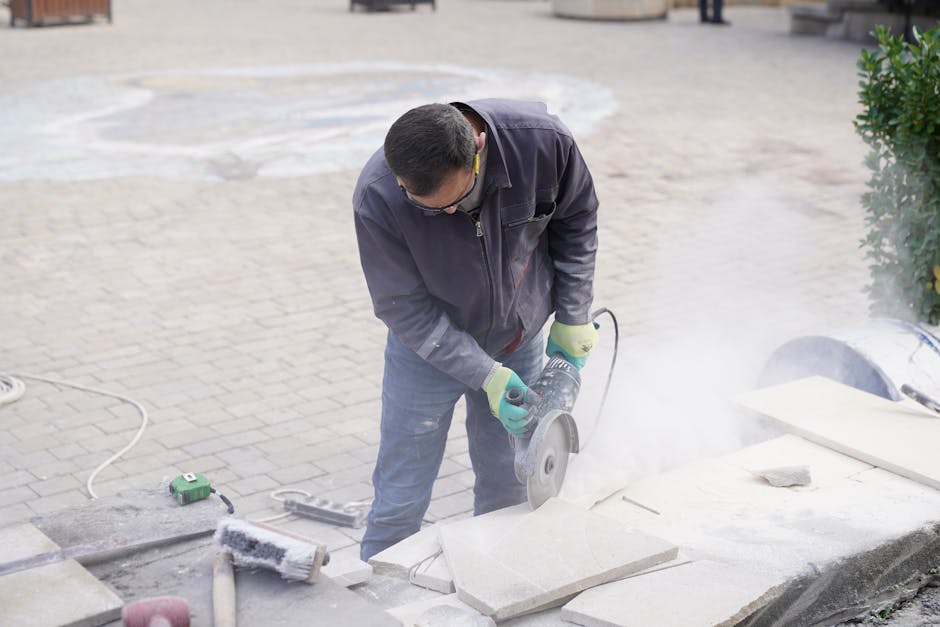
Silicosis is older than the Health and Safety Authority. Older than the state. Workers were dying from stone dust before anyone wrote a regulation about it. What makes 2026 different is that we are watching young men die from a disease we know exactly how to prevent.
The Material That Changed Everything
Traditional granite and marble contain silica, but engineered stone is different. Quartz slabs used in kitchen countertops can contain up to 93% crystalline silica by weight. That is three to four times more than natural stone. When you cut it dry, you generate a fine respirable dust that sits deep in lung tissue and never leaves.
The body's response is inflammation. Scar tissue forms. The lungs stiffen and shrink. Silicosis has no cure. There is no treatment that reverses the damage. A 28-year-old stonemason diagnosed today will watch his lung function decline for the rest of his life, however long that turns out to be.
Australia reported the first cluster of engineered stone silicosis cases in 2018. Workers in their 30s. Accelerated silicosis, not the slow-burning version that used to take decades of exposure. The timeline collapsed because the silica concentration is so high. Ireland, Britain, and across Europe, the same pattern followed.
What Dry Cutting Actually Means
A grinder or circular saw cutting engineered stone without water suppression throws a plume of fine dust directly into the breathing zone of the operator and anyone nearby. Without extraction or respiratory protection, a worker can absorb a significant dose in a single shift.
The occupational exposure limit for respirable crystalline silica in Ireland is 0.1 mg/m³ as an eight-hour time-weighted average. Dry cutting engineered stone can generate airborne concentrations many times above that limit within minutes. The limit exists. The enforcement existed. The deaths still happened because supervision and compliance lagged behind the material that was actually being used on the ground.
The HSE Ban and What It Signals
The UK's Health and Safety Executive moved to ban dry cutting of engineered stone and introduced strict controls on wet cutting, on-tool extraction, and respiratory protective equipment requirements. It is a straightforward statement: the risk from dry cutting is uncontrollable by any other means, so the practice stops.
That kind of regulatory intervention matters not because it solves everything overnight, but because it removes the space for employers to claim dry cutting was an acceptable option. The hierarchy of control pushed past PPE straight to elimination. That is the correct direction of travel.
For Ireland, the Health and Safety Authority has aligned controls under the Chemical Agents Code of Practice and the General Application Regulations. The obligations on employers are clear. Assess the risk. Control the dust at source. Use wet cutting methods. Provide on-tool extraction. Supply appropriate RPE. Monitor health. Keep records.
This sits alongside wider occupational asthma in the workplace obligations, where the same principle applies: if you generate a harmful airborne substance at work, you control it before it reaches someone's lungs.
The Specific Controls That Work
Wet cutting. Water suppression at the blade or disc reduces airborne dust at source. It works. It is not complicated. The objections are usually about mess or equipment cost. Neither objection holds up against a silicosis diagnosis.
On-tool extraction. Local exhaust ventilation attached directly to the cutting tool captures dust before it disperses. Combined with wet methods, it reduces exposure dramatically.
Respiratory protective equipment. A P3 filtering facepiece or powered air-purifying respirator is the last line of defence, not the first. RPE is not a substitute for source control. It is used alongside source control. A dust mask from a hardware shop is not adequate. Full stop.
Health surveillance. Workers cutting engineered stone need regular lung function testing. Spirometry once a year at minimum. The point is early detection, because early detection means earlier intervention, and earlier intervention means a better outcome. This is not a box-ticking exercise.
Segregation. Cutting should happen in a dedicated area with controlled ventilation. Other workers should not be sharing that space during cutting operations.
Where the System Keeps Failing
The tradespeople most at risk are often those working in small workshops or on-site installations. A sole trader cutting a kitchen worktop in a client's kitchen with no extraction, no water suppression, and a half-face mask that was not fit-tested is getting a significant silica dose. He probably does not know it. His employer, if he has one, may not know it either.
This is not ignorance in a vacuum. Information about silica risks has been available for years. The failure is in the chain between regulation and the workshop floor. A regulation that exists only in a PDF achieves nothing for a 25-year-old with an angle grinder and no induction.
When safety plans fail, it is rarely because no plan existed. It is because the plan was never connected to the actual work being done by the actual person doing it.
The Age Profile Is Not an Accident
The workers dying from accelerated silicosis are young because engineered stone is relatively new and because young workers entered the trade when it was already dominant. They accumulated high doses early. The latency period for accelerated silicosis can be as short as five years at high exposures. A worker who started cutting quartz at 22 can be diagnosed before 30.
This is not a story about a historical hazard catching up with us. This is happening now. The kitchens being installed this year are potentially the diagnoses being made in 2030.
The Simplest Statement
The controls are not experimental. They are not expensive relative to the cost of a worker's lungs. Wet cutting, extraction, proper RPE, and health surveillance will prevent silicosis. Every case diagnosed after a workplace where those controls were absent is a preventable death or a preventable disability that the employer chose not to prevent.
The material is not going away. The choice is whether the people cutting it go home with functional lungs.