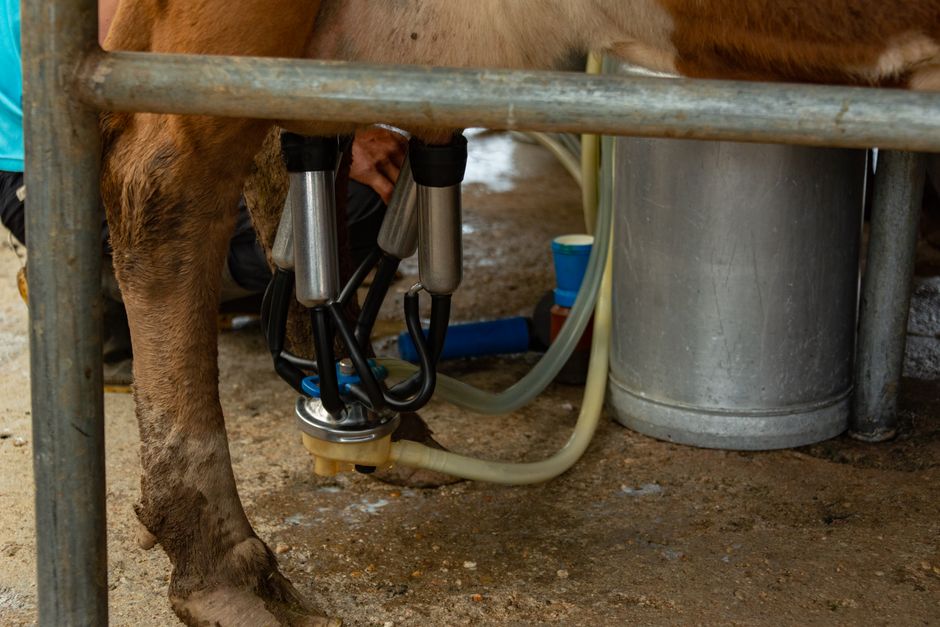
Biofilm doesn't look like anything. That's the problem. It's not the greenish slime on a neglected surface or the obvious mould you spot in a cold room corner. It's a microscopic community of bacteria that has anchored itself to the inside of your milk lines, your plate cooler, your CIP return pipework, and it is quietly producing pathogens every single milking.
Recent prosecutions across Ireland and the UK involving contaminated dairy product have a pattern. The physical plant looks clean. The operator has records. The cleaning schedule is posted on the wall. And yet Listeria, Pseudomonas, or thermophilic Bacillus species are showing up in finished product, in environmental swabs, and eventually in court documents.
The problem isn't negligence in the obvious sense. It's a structural misunderstanding of where contamination actually hides and what it takes to remove it once it's established.
What Biofilm Actually Is
Bacteria don't just float through your milk lines in suspension. Within hours of landing on a surface, certain species begin secreting a polysaccharide matrix, a sticky, protective layer that glues them to the pipe wall and shields them from sanitisers. Once that matrix matures, it can withstand chlorine concentrations that would destroy planktonic bacteria by a factor of 500 or more.
That figure comes from peer-reviewed food microbiology research and it should stop you cold. If your CIP cycle is designed around killing free-floating bacteria, it is not designed around killing biofilm. Those are two different problems requiring two different approaches.
The species you are most likely to find in a dairy biofilm are not random. Thermoduric bacteria, those which survive pasteurisation temperatures, are a consistent find. So is Listeria monocytogenes, which thrives in cold, wet environments and has a particular affinity for rough surfaces, gasket materials, and pipe joints. Pseudomonas aeruginosa produces a biofilm that actively recruits other species. Once it establishes, your contamination profile gets more complex over time, not less.
Where Biofilm Forms
The locations that generate the most convictions are not the obvious ones. They are the spaces that routine visual inspection cannot reach.
Pipe joints and elbows. Turbulent flow breaks down at bends. Velocity drops. Bacteria settle. The inner radius of a 90-degree elbow in a milk transfer line is one of the highest-risk points in your entire system, and you cannot see it without dismantling the fitting.
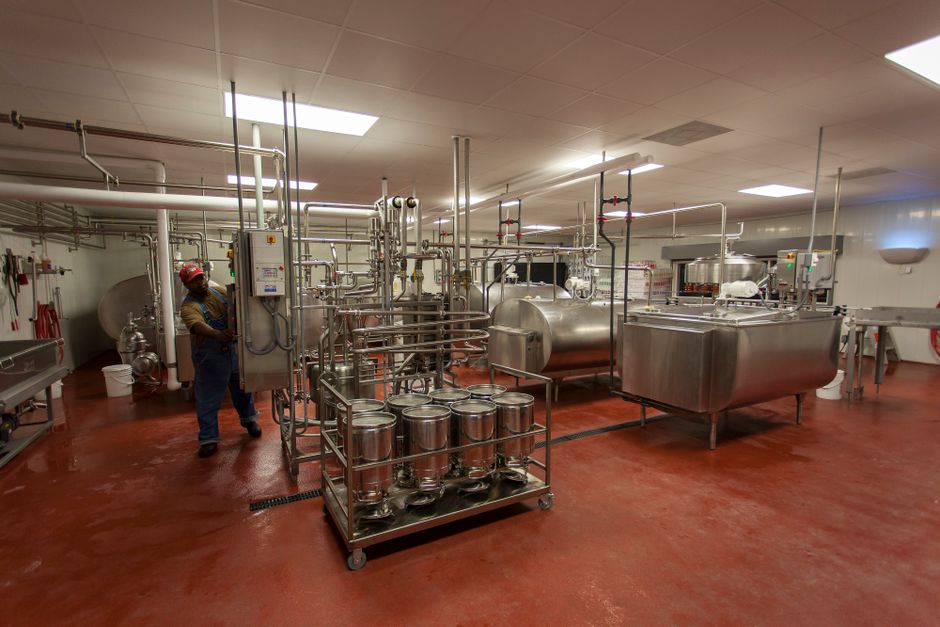
Plate heat exchangers. The corrugated plates create flow channels with varying velocity profiles. Dead zones form. Gaskets degrade at the edges and create micro-harbourage sites that CIP solution touches but does not penetrate adequately. A plate cooler that looks clean on visual inspection can be carrying a mature biofilm inside a degraded gasket channel.
Balance tanks and silos. The area around inlet valves, agitator seals, and the underside of lids accumulates milk residue that standard CIP cycles can miss if flow patterns are not verified during system design.
Flexible hoses. Every connection point is a risk. Hoses that are kinked, aged, or stored in loops create pooling points. The internal surface of a flex hose that is three years old and showing external surface cracking is not a cleanable surface anymore. Replace it.
The Temperature and Flow Rate Numbers That Actually Matter
CIP works through three mechanisms: chemical action, thermal action, and mechanical action (velocity). Remove any one of the three and you are not cleaning, you are rinsing.
For a dairy line CIP cycle, the numbers are not suggestions:
Caustic wash temperature: 70 to 80 degrees Celsius at the return, not at the supply. If you are measuring temperature at the supply and your return is 15 degrees cooler by the time it reaches the end of a long run, your caustic is not working at the far end of the circuit.
Flow velocity: 1.5 metres per second minimum in circular pipework to generate turbulent flow. Below that, you are in laminar flow territory. Laminar flow does not generate the shear force required to mechanically disrupt biofilm. Most operations measure flow at the pump. Few measure it at the distal end of the circuit, where gravity, elevation change, and pipe diameter variation have already reduced it.
Contact time: Minimum 10 minutes for caustic, 5 minutes for acid rinse, at temperature, at velocity. Not 10 minutes from pump start. Ten minutes of verified flow at temperature and velocity at every point in the circuit.
Sanitiser concentration: Peracetic acid at 100 to 200 ppm for final sanitisation, with full draining before milk contact. A sanitiser film that is too concentrated leaves residue that affects product quality. Too dilute and it is decorative.
If your CIP system is not logging temperature and flow rate at multiple points in the circuit with timestamps, you do not have verified cleaning. You have cleaning theatre.
Why Inspectors Are Finding What Operators Are Missing
Environmental Health Officer inspections in dairy operations now routinely include environmental swabbing of non-product-contact surfaces as well as pipework internals. The shift in enforcement focus is deliberate. Regulators understand that a clean bulk tank swab result tells you very little about what is happening inside your plate cooler or in the return leg of your CIP circuit.
The prosecution cases emerging over the last three years share common features. Temperature monitoring that covered the supply but not the return. Flow rates set by original system commissioning that had never been verified after equipment changes or pipeline extensions. Gaskets that had not been replaced on a defined schedule. CIP cycles that had been shortened over time to reduce water and chemical costs without a documented risk assessment supporting that change.
That last one is the one that tends to appear in the charge sheet.
Building a Protocol That Actually Works
The dairy industry has already seen the consequences of cleaning systems that look adequate on paper but fail in practice. An effective protocol is not complicated, but it requires discipline.
First, map your circuit. Every metre of pipework, every valve, every joint, every elevation change. Identify the distal points and the dead legs. There should be no dead legs. If there are, eliminate them or document them as critical control points requiring manual cleaning.
Second, validate your CIP parameters at commissioning and after any system change. Use data loggers, not just panel gauges. Temperature and flow at the return, not just the supply.
Third, put gasket replacement on a calendar, not a condition assessment. Visual inspection of gaskets misses internal degradation. Set a replacement interval, 12 months maximum for high-wear sites, and stick to it.
Fourth, run periodic full dismantling inspections of your plate cooler. Quarterly if you are processing high volumes. Document what you find.
Fifth, use environmental swabbing of non-obvious sites as a routine monitoring tool, not just a response to a failed bulk tank result. Swab the return pipework. Swab the inside of balance tank lids. Swab valve bodies. Do it on a rotation so every critical point is covered across a defined cycle.
The bacteria are not hiding because they are clever. They are there because the conditions allowed them to establish and the cleaning regime was not designed to remove them. Change the conditions, validate the cleaning, and the biofilm does not get the chance to become your problem in a prosecution document.