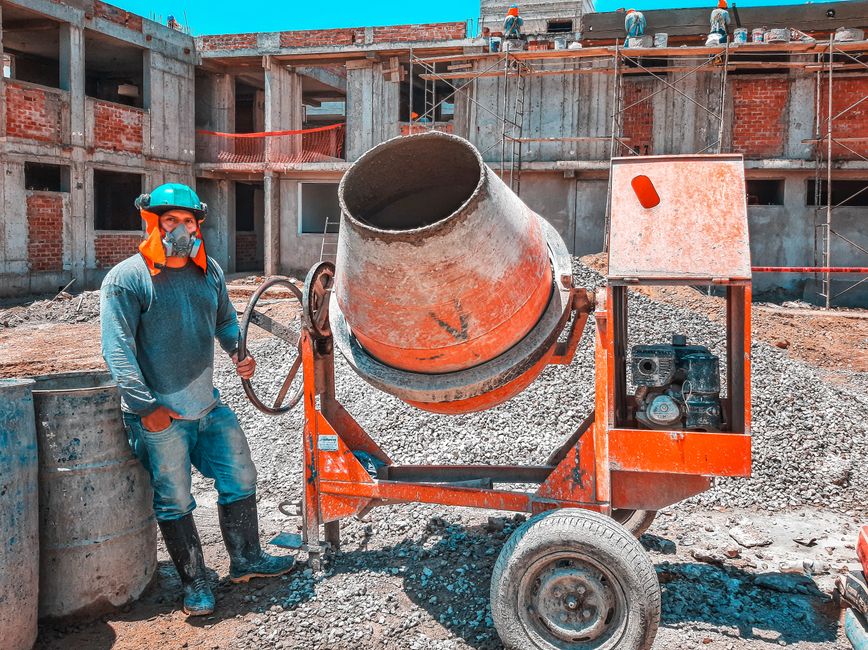
The most dangerous construction site in Ireland probably has a skip outside, a Transit van, and three lads who've worked together for years. No safety officer. No site manager doing walk-rounds. No one watching.
The conversation about construction safety in Ireland defaults to the big players. Major infrastructure projects, large residential schemes, the kind of sites with welfare units and full-time project supervisors. Those sites get scrutinised. They get visited. They carry the overhead of compliance because they have the overhead of scale. And yet 83% of construction fatalities happen on sites with four workers or fewer. The industry's deadliest setting is the one getting the least attention.
Why Small Sites Kill More
It is not that small-site workers are less skilled or more reckless. The problem is structural.
On a large site, there are systems that catch things before they turn fatal. Toolbox talks happen. Someone checks that the excavator operator has a line-of-sight to the banksman. There is a chain of responsibility. On a micro-site, that chain is usually one person long, and that person is also operating the machinery, reading the drawings, and answering calls from the client.
Plant safety is where this plays out most brutally. A mini-excavator on a small domestic job gets used the same way a full-size machine gets used on a managed site, but without the same controls. No exclusion zones marked out. No formal briefing on pedestrian separation. The homeowner wandering out with a cup of tea asking if you want sugar. The delivery driver reversing down the side passage without anyone flagging him in. These are not hypotheticals. These are the circumstances that precede real incidents, and machinery blind spots that kill are just as lethal when the machine is small and the site is someone's back garden.
The Supervision Gap
The Safety, Health and Welfare at Work (Construction) Regulations 2013 require a project supervisor for the construction stage on any project above certain thresholds. Below those thresholds, the obligation to manage safety does not disappear. It just has no designated person to carry it.
A self-employed sole trader doing a single-storey extension is legally required to comply with the same core duties as a main contractor on a commercial development. Risk assessments. Safe systems of work. Adequate training for anyone they bring onto the site. In practice, the file that should exist often does not. And the HSA inspection that might catch the gap often does not happen either, because the inspector-to-site ratio in Ireland means small jobs fall through.
This is not an argument for less enforcement on large sites. It is an argument for acknowledging that the current model disproportionately scrutinises the sector of the industry that is already safer.
The Plant Problem Specifically
Ground-working plant on small sites carries a particular risk profile. Compact excavators, dumpers, telehandlers on tight driveways and rear gardens. Operators are often experienced but operating in environments with no traffic management plan, no exclusion zone barriers, and no agreed signalling system.
Reversing deaths on Irish sites follow a consistent pattern: plant moving in reverse, a person in a position neither could see, no banksman present or in the wrong position. On a large managed site, a reversing management plan is a standard document. On a micro-site, the plan is often shouting someone's name.
Dumper trucks are the specific machine that appears repeatedly in small-site fatalities across Ireland and the UK. They are fast enough to cause fatal trauma, low enough that visibility to the front and sides is restricted, and common enough that operators treat them as unremarkable. The seatbelt issue compounds this. Operators on short-run tasks routinely skip belting in. That decision costs lives when overturns happen, and overturns happen on ground that has not been assessed.
What Actually Needs to Change
Stop treating the Safety Statement as a filing exercise. Every employer with employees, and every self-employed person on a construction site, must have one. It needs to actually describe the work being done, the specific plant being used, and the specific controls in place. A generic downloaded template with a company name dropped into the header is not a safety statement. It is paper.
Assess the ground before plant goes on it. A mini-excavator on unstable or recently disturbed ground can overturn in the same way a full-size machine can. Walk the site. Know where the services are. Know where the soft spots are. Do this before the machine is delivered.
Establish a no-go zone every single day. Even on a site with one machine and two workers, the exclusion zone around moving plant must be agreed and communicated. The homeowner, the neighbour, the delivery driver, the apprentice nipping across to get a tool. Everyone who could enter the zone needs to know not to.
Check the competence of plant operators formally. Safe Pass and a CSCS card tell you someone sat in a room at some point. They do not confirm the person operating your dumper has specific, current competence for the machine in front of them. CPCS and CSCS operator cards by machine category exist for a reason. Use them.
Plan the first aid response. On a large site, there is usually a trained first aider nearby and a defined procedure for calling emergency services and guiding them to the location. On a small site with three workers, someone needs to have thought about this in advance. What is the site address? Which hospital is closest? Who calls the ambulance while someone else manages the casualty? Recovery room essentials for sites where help takes 30 minutes are not just for remote farm work. Urban micro-sites in tight housing estates can be just as hard for an ambulance to access quickly.
The Familiarity Problem
There is a specific danger that comes with small crews who know each other well. Familiarity builds trust, and trust is valuable, but it also erodes the formality that keeps people safe. Nobody wants to be the one who calls a stop and insists on doing a proper exclusion zone briefing when the other two lads have been working with each other for fifteen years. The culture on micro-sites runs on efficiency and mutual understanding, and that culture has a body count.
The solution is not to make small sites feel like big sites. It is to build in the five or ten minutes of deliberate thinking that the big sites have systematised. Before the plant moves, before the trench opens, before the scaffold goes up. Not paperwork. Actual thinking, out loud, with whoever is on site that day.
The big sites are not perfect. But they are not where 83% of the people are dying.