We spend years teaching small children to stop, look, and listen. Then we do almost nothing for the next decade. And we wonder why young drivers keep dying.
The numbers are not subtle. Drivers aged 17 to 24 represent roughly 10% of licence holders in Ireland but account for a disproportionate share of serious road collisions every year. The RSA has flagged this repeatedly. The problem is not that young people are reckless by nature. The problem is that we built a road safety education system shaped like a cliff. Intensive at six years old, nearly invisible at sixteen.
That cliff has consequences. When a teenager finally sits behind the wheel, they carry exactly zero hours of formal hazard awareness training for the road environment they are about to enter. What they carry instead is a decade of muscle memory as a pedestrian or passenger, most of it built in the back seat staring at a phone.
What Primary School Gets Right
Green Schools, the Road Safety Authority's primary campaigns, and initiatives like Walk on Wednesday do solid work. Children learn pedestrian behaviour through repetition. They learn about stopping distances in very concrete terms. They learn that roads are dangerous. For ages five to twelve, this approach is well-calibrated.
The content is physical and experiential. Kids walk routes. They practice crossings. They observe traffic from a low vantage point. Teachers embed the lessons over weeks, not in a single assembly. It works because it treats children as active participants in their own safety, not passengers in a presentation.
Then they go to secondary school, and road safety education largely stops.
The Secondary School Vacuum
Ask a secondary school teacher what formal road safety content appears on their timetable. Most will struggle to name anything beyond the occasional Road Safety Week poster or a SPHE class that touches on drink driving. The RSA does run some secondary programmes, and organisations like Avert run impact-based presentations with collision survivors. These are valuable. They are also not systematic.
Distracted driving in Ireland kills people every year, and yet phone use while driving gets more screen time in social media campaigns than in any classroom. The irony runs deep given that most teenagers first encounter distracted driving as passengers in cars driven by adults doing exactly that.
The gap matters because secondary school is precisely when young people start spending serious time on roads unsupervised. Cycling to school. Walking home at night. Getting lifts from older friends who have just passed their test. The hazard awareness they need is not pedestrian-level any more. It is road-user-level. And they are not getting it.
Hazard Perception: Taught Late, Tested Badly
Ireland's driving test includes a hazard perception element. Learners watch video clips and click when they see a developing hazard. It is better than nothing. It is also the first time most young people have ever been formally asked to think this way, and they encounter it at seventeen or eighteen when they are already deep in Accompanied Driving Licence territory.
Hazard perception is a trainable skill. Research from the UK's Transport Research Laboratory has shown that targeted practice measurably improves a young driver's ability to identify risks early. The earlier that training starts, the more embedded the skill becomes. Leaving it until licence preparation means you are teaching a cognitive habit in weeks that should have been built over years.
Compare this to how we treat other complex skills. A teenager who wants to play rugby spends years developing spatial awareness, reading opposition movement, anticipating collisions. We do not hand them a gumshield the week before their first senior match and call it preparation. Road safety gets exactly that treatment.
The Passenger Years Are Being Wasted
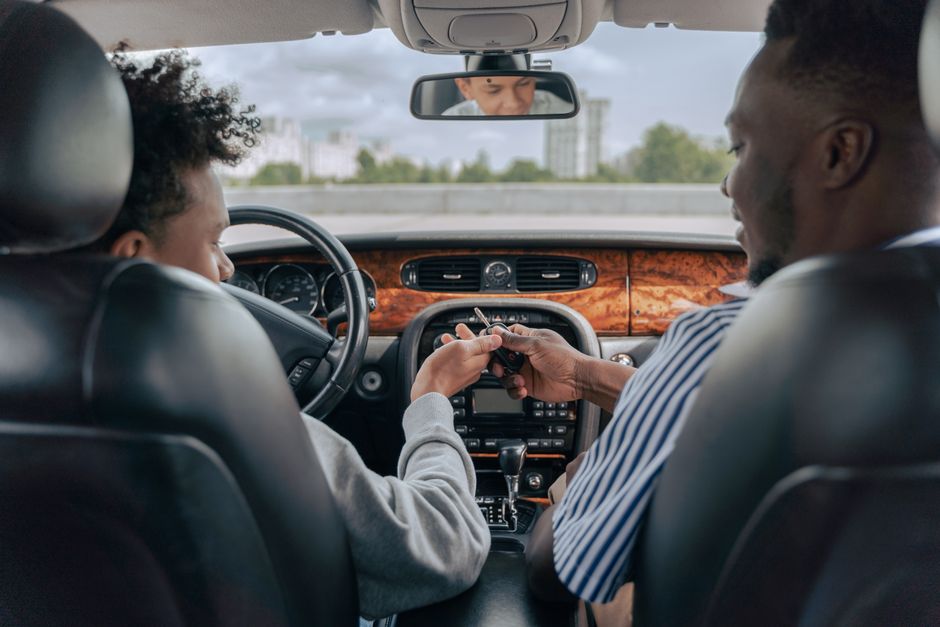
Between the ages of twelve and seventeen, most young people spend significant time as car passengers. This is the perfect environment for informal hazard awareness development, and it is almost entirely wasted.
A young person watching an experienced driver navigate a busy junction, anticipate a cyclist in a blind spot, or react to a car pulling out from a side road is absorbing information. They are not absorbing it systematically. Nobody is narrating the decision-making. Nobody is explaining why the driver slowed before the bend or checked the mirror twice at that particular junction. The learning is passive and incomplete.
Structured commentary driving, where the driver talks through their decisions in real time, has been used in professional driver training for decades. Applying even a light version of this during family journeys would give teenagers five years of informal hazard awareness before they ever sit in the driver's seat. Schools could prompt this. Parents could be briefed to do it. Neither is happening at scale.
What a Joined-Up System Would Look Like
The fix is not complicated. It requires joining up what already exists rather than inventing new programmes from scratch.
Hazard awareness content should appear in secondary school SPHE from first year onwards. Not crash-footage shock tactics. Structured observation exercises. Video-based hazard identification. Discussion of why specific road environments are dangerous and for whom. The RSA has materials that could support this with minimal curriculum disruption.
The Accompanied Driving Licence period, currently requiring 12 lessons with an Approved Driving Instructor and at least 7 hours of Essential Driver Training, should include explicit hazard perception modules rather than treating it purely as vehicle control practice. Instructors already cover this informally. Making it mandatory and assessed would standardise the quality.
Cyclist and pedestrian safety on Irish roads rarely features in young driver training either, despite cyclists and pedestrians being among the most vulnerable people young drivers will encounter. That is a structural failure, not an oversight.
Parents need guidance, not lectures. A one-page brief sent home during Transition Year explaining how to make car journeys productive for hazard awareness costs nothing and could shift behaviour at scale.
The Turn
The reason this gap persists is not ignorance. Everyone in road safety knows it exists. The reason it persists is that road safety education in schools is not mandatory in any meaningful enforced sense, and the RSA's limited budget goes where it creates the most visible impact, which means primary schools and post-crash campaigns, not the unglamorous middle years.
A system that teaches children to cross the road safely and then hands teenagers a licence without filling the decade in between is not a road safety system. It is two unconnected initiatives with a very dangerous gap between them.
Close the gap. The skill is teachable. The years are available. The only thing missing is the decision to use them.