Silica dust kills slowly, which is precisely why it keeps killing. No immediate pain, no obvious wound, no ambulance on day one. Just lungs quietly scarring over ten or twenty years until a worker can no longer climb a flight of stairs.
The tragedy is not that we lack knowledge. The Control of Substances Hazardous to Health regulations have covered respirable crystalline silica since the 1990s. The Health and Safety Authority has published guidance, run campaigns, and issued enforcement notices. The science is settled. Silica particles smaller than 10 microns lodge deep in lung tissue, trigger inflammation, and cause silicosis, a progressive and irreversible fibrosis. Prolonged exposure also raises the risk of lung cancer and kidney disease. We know this. We have known this for a generation. Workers are still dying from it.
The question is not what silica does to the body. The question is why the controls that exist on paper are not showing up on sites.
The Exposure Gap Nobody Wants to Name
Walk onto any active construction site in Ireland today. Cutting kerbs with an angle grinder, dry-grinding concrete floors, drilling through blockwork without water suppression. These are ordinary daily tasks generating dust levels that can exceed the workplace exposure limit of 0.1 mg/m³ by a factor of ten or more within minutes.
The problem is visibility, or the lack of it. Respirable silica particles are invisible to the naked eye. Workers see a bit of dust settle on their boots and think nothing of it. What they cannot see is the fine fraction hanging in the air long after the visible cloud has cleared. That is the fraction that reaches the alveoli. That is the fraction doing the damage.
Employers know they are supposed to control it. Many simply do not rate the risk as urgent because no one collapses on the day. Occupational lung disease operates on a delay that makes it uniquely difficult to link to any specific site or employer. By the time a worker is diagnosed with silicosis, he may have worked for fifteen different contractors. The legal trail is cold. The accountability is diffuse. And so the behaviour continues.
What the Regulations Actually Require
Irish law, under the Safety, Health and Welfare at Work (Chemical Agents) Regulations, requires employers to apply the hierarchy of controls. Elimination first. If you can avoid cutting silica-containing materials, do that. Substitution next. Use pre-cut materials where possible. Then engineering controls: on-tool water suppression, local exhaust ventilation, or enclosed cabs on plant. Respiratory protective equipment comes last, not first.
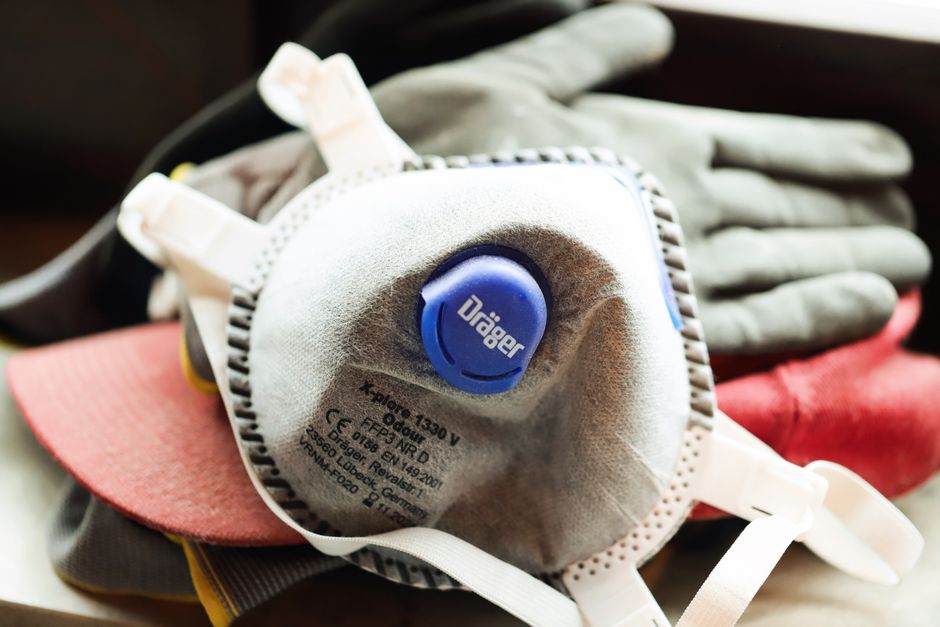
This hierarchy matters because RPE is the control most employers reach for immediately. Whether RPE actually does what workers assume it does is a separate and uncomfortable question, but even a perfectly fitted FFP3 mask is a backup measure, not a solution. A mask that is worn under the chin during the cut and pulled up for the site manager's visit is not a control at all.
Water suppression on angle grinders reduces airborne silica by around 90% when used correctly. Wet cutting costs almost nothing to implement. It works. It is not complicated. The barrier is not technology or cost. It is habit, supervision, and a site culture that treats dust as an annoyance rather than a carcinogen.
The Materials That Demand the Most Attention
Not all silica sources carry equal risk. Engineered stone used in kitchen worktop fabrication became notorious after a wave of accelerated silicosis deaths in young workers, leading to a ban in several jurisdictions. That ban carries direct implications for Irish construction sites still handling legacy stock or importing materials.
On standard construction sites, the highest-risk tasks are:
Dry cutting or grinding concrete, sandstone, or granite. These materials contain 25% to 70% silica by weight. A four-inch angle grinder cutting a concrete block dry can generate enough respirable dust in sixty seconds to exceed the daily exposure limit for an eight-hour shift.
Scabbling and chasing. Breaking out concrete surfaces and chasing walls for services creates sustained, high-concentration clouds in enclosed spaces where ventilation is already poor.
Abrasive blasting. Sand blasting with silica-containing abrasives is now prohibited in most contexts, but surface preparation work using other methods on old concrete still releases silica from the substrate.
Demolition. Breaking up old concrete and masonry, particularly in confined areas, produces exposures that dwarf most new-build activities.
What Workers Can Actually Do
The hierarchy of controls is an employer obligation. That does not mean workers are powerless.
Know your rights. Under the Safety, Health and Welfare at Work Act 2005, you have the right to information about substances you work with, and the right to raise concerns without victimisation. If a site does not have dust controls in place for high-risk tasks, that is a reportable matter to the HSA.
Refuse dry cutting. Any competent operative can decline to carry out a task in a way that presents an uncontrolled risk to health. This is not a grey area. The law supports it.
Use RPE properly or not at all. A poorly fitted mask gives false confidence while providing minimal protection. FFP3 is the minimum standard for silica work. It must be fit-tested, not just handed out from a box on the cabin shelf.
Push for health surveillance. Workers regularly exposed to silica are entitled to periodic lung function monitoring under Irish law. This is not a favour from the employer. It is a legal requirement. Early detection does not reverse silicosis, but it can slow progression by removing the worker from further exposure before the damage becomes catastrophic.
Document your own exposure. Keep a record of the sites you work, the tasks you perform, and the controls in place. If you develop a respiratory condition in ten years, that record is the difference between a successful claim and an unresolvable dispute.
Why Campaigns Alone Do Not Work
The HSA has run awareness initiatives targeting silica dust. The Health and Safety Executive in Britain has done the same, repeatedly, over decades. Awareness is not the constraint. Every safety officer in construction knows silica is dangerous. The constraint is enforcement density, site culture, and the economics of the labour market.
Subcontracting chains mean that the worker cutting kerbs has no direct employment relationship with the principal contractor setting site rules. The principal contractor has limited sight of what the subbies are doing on any given afternoon. The subbies are under price pressure that makes any slowdown for wet cutting or ventilation feel like a cost they cannot absorb. Nobody in the chain intends to give anyone lung disease. It happens anyway, systematically, because the system does not force any single actor to change behaviour at the moment of exposure.
Enforcement actions that result in prosecutions and significant fines do shift behaviour. Fear of financial consequence reaches parts that awareness campaigns cannot. But enforcement requires inspectors on sites at the right moment, and Ireland does not have enough of them to cover every cut-off saw in the country.
The controls work when they are used. That is the maddening part. Wet cutting, LEV, enclosed cabs, proper RPE. These are not experimental technologies. They exist, they are affordable, and they stop the dust reaching the lung. The gap between knowing that and doing it consistently, on every site, on every task, every day, is where people are still paying with twenty years of their lives.
Silica does not care about awareness campaigns. It responds to controls.